Listen without rushing to advise
Nine months · Eight core modules · Supervised practicum · Small learning cohort
Join the interest listRAHAO SCHOOL OF LIFE PRESENTS
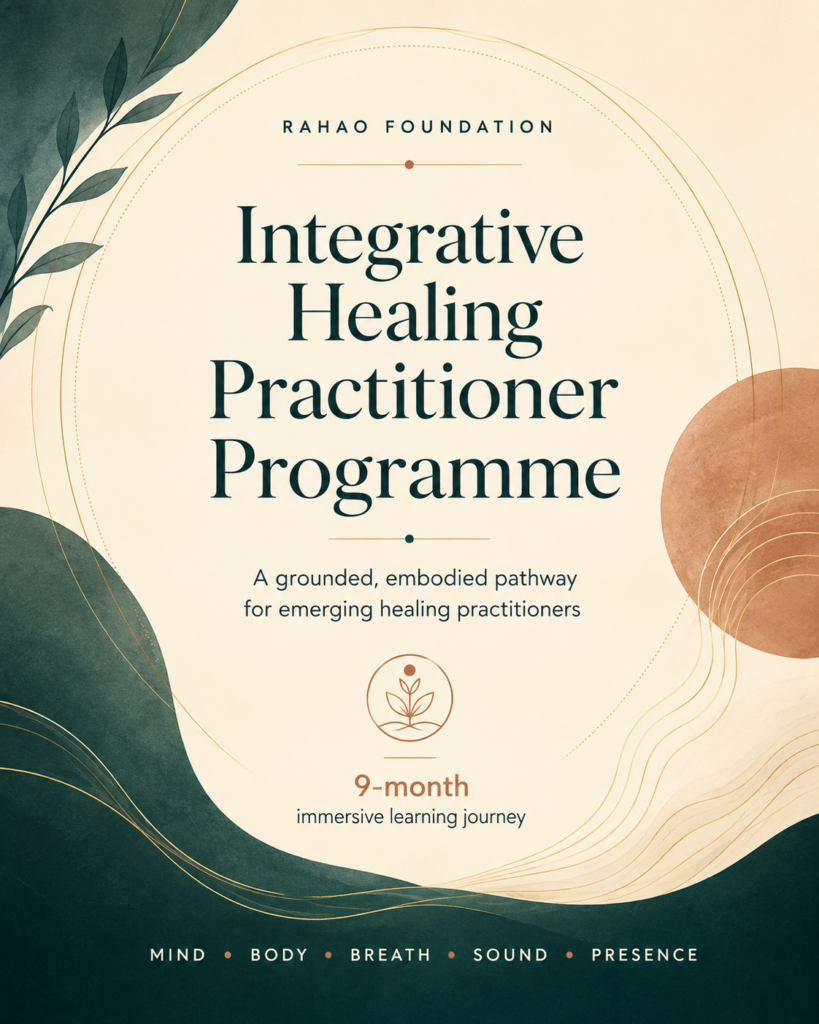
Rahao Integrative Healing Practitioner Programme
A nine-month pathway in embodied wellbeing, ethical facilitation and the healing arts.
Become the space before you become the practitioner.
A nine-month immersive learning journey for those who feel called to support others through breath, sound, meditation, movement, nature, nourishment, emotional awareness and conscious living. This programme goes far beyond learning a collection of techniques. It invites you to deepen your own practice, understand the responsibility of holding space and gradually develop the skills needed to facilitate meaningful wellbeing experiences for individuals and groups.
THE INNER FOUNDATION
The path of a practitioner begins within.
People do not only need more techniques, advice or information. They need spaces where they can slow down, feel respected, reconnect with their bodies and listen to what is happening within them.
They need practitioners who are grounded enough to stay present, humble enough not to impose answers and responsible enough to understand the limits of their role.
Before learning how to guide others, participants are invited to explore their own inner world, daily rhythms, patterns, emotions, relationships and ways of responding to life.
The quality of a healing space depends not only on the practice being offered, but also on the presence of the person offering it.
A NATURAL NEXT STEP
From the Wellbeing Course to the practitioner pathway.
The eight-session Rahao Wellbeing Course introduces participants to eight interconnected doorways into wellbeing. The Practitioner Programme expands each doorway into a month-long module of study, personal practice, experiential learning and facilitation training.
NOT JUST ANOTHER CERTIFICATION
A journey of personal practice and professional responsibility.
Rahao does not train practitioners to fix people or present themselves as having all the answers. The purpose is not to become powerful over another person. It is to become more present, responsible and trustworthy in service.
Understand the importance of safety, consent and choice
Guide practices with sensitivity rather than intensity
Notice their own triggers, projections and limitations
Create experiences suited to the person, group and context
Recognise when professional referral may be necessary
Support self-awareness without making clinical promises
Help learning return gently to everyday life
This programme may be meaningful for you when…
- You feel called to work in wellbeing, healing or conscious-living spaces
- You want to move from personal practice towards responsible facilitation
- You already practise yoga, meditation, breathwork, sound, movement, coaching, education or another helping modality
- You wish to develop an integrated mind-body approach rather than relying on one technique
- You want to understand how to hold individual and group spaces safely
- You are seeking a deeper personal journey before beginning professional practice
- You want to bring wellbeing practices into schools, organisations, communities, retreats or private sessions
- You value humility, ethics, self-awareness and ongoing learning
You do not need to arrive as an expert. You need curiosity, sincerity, emotional responsibility and the willingness to practise consistently.
This may not be the right pathway when…
- You are seeking a quick certificate without sustained personal practice
- You want techniques primarily to gain authority over others
- You are unwilling to receive feedback or reflect on personal patterns
- You expect one method to solve every emotional or physical difficulty
- You wish to practise outside your competence or professional scope
- You cannot commit to attendance, practice, supervision and ethical guidelines
Becoming a practitioner is not only about what you know. It is also about how you relate, listen, respond and take responsibility.
THE RAHAO PRACTITIONER FOUNDATION
Eight principles that guide the entire programme.
Presence before technique
The practitioner’s quality of attention matters as much as the method being offered.
Safety before depth
Deeper work cannot be forced. Safety, pacing and choice create the conditions for meaningful exploration.
Consent before participation
Every participant has the right to choose, pause, modify or decline a practice.
Experience before advice
People often understand themselves more deeply through direct experience than through repeated instruction.
Relationship before performance
Healing spaces are built through trust, attunement and respectful human connection.
Integration before expansion
A powerful experience becomes valuable when it can enter daily life gently and sustainably.
Humility before authority
Practitioners must understand the limits of their role and remain willing to learn, refer and receive supervision.
Service before self-promotion
The work is centred on the wellbeing and agency of the participant—not the image of the practitioner.
THE NINE-MONTH LEARNING JOURNEY
Eight core modules and one supervised integration month.
Each month explores one major dimension of wellbeing through personal practice, live teaching, experiential sessions, reflective inquiry, peer learning, facilitation demonstrations, ethical and safety considerations, guided assignments, practice-session design, feedback and mentoring.
01
MONTH 1The Pause
Presence, Grounding and the Inner Foundation of a Practitioner
The Pause
Presence, Grounding and the Inner Foundation of a Practitioner
Before practitioners can hold space for others, they need to understand how they arrive in a space themselves. This module explores the foundations of presence, grounding, self-observation and practitioner readiness.
Participants will explore
- The difference between reacting, advising and holding space
- Grounding through body, breath, environment and attention
- Recognising personal stress responses
- Developing a consistent reflective practice
- Listening without immediately interpreting
- Beginning and closing a wellbeing session
- Creating emotional and physical safety
- The practitioner’s inner state as part of the facilitation space
Practitioner focusHow do I remain present without taking over another person’s process?
02
MONTH 2Rooted in Nature
The Five Elements, Ecological Awareness and Nature-Based Practice
Rooted in Nature
The Five Elements, Ecological Awareness and Nature-Based Practice
Nature is not treated merely as a beautiful background. It becomes a teacher, mirror and living environment for wellbeing. Participants explore earth, water, fire, air and space as experiential frameworks for awareness and balance.
Participants will explore
- The five elements as experiential principles
- Grounding, flow, vitality, movement and spaciousness
- Nature-based awareness practices
- Mindful walking and sensory listening
- Designing accessible outdoor experiences
- Working respectfully with weather, place and environment
- Facilitating simple nature-reflection processes
- The relationship between personal wellbeing and ecological belonging
Practitioner focusHow can nature support awareness without becoming another activity to perform?
03
MONTH 3Food as Medicine
Nourishment, Relationship and the Wisdom of Everyday Eating
Food as Medicine
Nourishment, Relationship and the Wisdom of Everyday Eating
Food is explored not as a rigid diet system, but as a relationship involving body signals, culture, memory, availability, rhythm and care. The module supports practitioners in facilitating conversations around nourishment without prescribing beyond their training.
Participants will explore
- Food as physical, emotional, cultural and relational nourishment
- Hunger, fullness, energy and body awareness
- Mindful and conscious eating practices
- Everyday rhythms that support wellbeing
- Traditional food wisdom and personal context
- Moving beyond fear-based and trend-based food language
- Ethical boundaries around nutritional advice
- Recognising when referral to a qualified nutrition or medical professional is needed
Practitioner focusHow can I encourage a caring relationship with food without imposing one perfect way of eating?
04
MONTH 4Vibration, Sound and Naad
Listening, Resonance and Sound-Based Wellbeing
Vibration, Sound and Naad
Listening, Resonance and Sound-Based Wellbeing
Sound can influence attention, breathing, emotional state and the felt quality of a space. This module introduces sound not as a promise of cure, but as a doorway into listening, regulation, expression and inner awareness.
Participants will explore
- The foundations of vibration and resonance
- Deep listening and receptive awareness
- Voice, humming and simple vocal practices
- Silence as an essential part of sound facilitation
- Working with bowls, bells, drums and other instruments
- Creating a coherent sound journey
- Volume, pacing, proximity and participant comfort
- Sound-session preparation, consent and contraindications
- Closing and integrating a sound experience
Practitioner focusHow do I use sound with sensitivity rather than overwhelm?
05
MONTH 5Breath into Being
Conscious Breathing, Movement and Embodied Regulation
Breath into Being
Conscious Breathing, Movement and Embodied Regulation
Breath is an intimate and powerful practice. It must be approached with care, appropriate pacing and respect for individual capacity. This module develops a responsible foundation for guiding accessible breath and movement practices.
Participants will explore
- Observing the natural breath before changing it
- The relationship between breath, attention and emotion
- Grounding and settling practices
- Energising and mobilising practices
- Breath combined with gentle movement
- Humming, extended exhalation and rhythmic breathing
- Choice-based guidance and modifications
- Screening, contraindications and participant communication
- Recognising signs of overwhelm
- Integrating breath practices into daily life
Practitioner focusHow can breath be offered as an invitation rather than an instruction to push harder?
06
MONTH 6What the Body Remembers
Emotional Awareness, Patterns and Compassionate Inquiry
What the Body Remembers
Emotional Awareness, Patterns and Compassionate Inquiry
Emotional experiences may be reflected through tension, posture, sensation, avoidance, restlessness and repeated patterns. This module helps practitioners support body-based and emotional awareness without diagnosing, treating or forcing disclosure.
Participants will explore
- The body as a source of information
- Sensation, emotion, thought and behaviour
- Recognising triggers and protective responses
- Creating space between experience and reaction
- Compassionate inquiry and reflective questioning
- Supporting emotional expression without interpretation
- Pacing, grounding and returning to the present
- Boundaries around personal stories and disclosure
- Scope of practice and referral
- Practitioner self-awareness during emotionally charged moments
Practitioner focusHow do I remain compassionate without becoming responsible for fixing another person’s emotional world?
07
MONTH 7The Art of Inner Stillness
Meditation, Awareness and Dhyanfulness
The Art of Inner Stillness
Meditation, Awareness and Dhyanfulness
Stillness is not the absence of thought, feeling or movement. It is the capacity to remain in relationship with experience more consciously. Participants learn to guide meditation and awareness practices in an accessible, inclusive and grounded manner.
Participants will explore
- Attention, awareness and witnessing
- Different doorways into meditation
- Breath, body, sound and open-awareness practices
- Working with restlessness and distraction
- Guiding silence without creating pressure
- Trauma-sensitive and choice-based meditation language
- Adapting practices for different participants
- Developing a personal meditation discipline
- Dhyanfulness in relationships and daily activity
- Opening and closing guided meditations
Practitioner focusHow can I help people meet the present moment without turning meditation into another performance?
08
MONTH 8Living Awake
Integration, Conscious Relationships and Practitioner Identity
Living Awake
Integration, Conscious Relationships and Practitioner Identity
The final core module brings the learning into ordinary life. Participants explore how awareness expresses itself through choices, communication, relationships, work, service and the way a practitioner lives outside formal sessions.
Participants will explore
- Turning insight into sustainable daily practice
- Conscious habits and personal rhythms
- Relational awareness and communication
- Practitioner boundaries and energy management
- Working without creating dependency
- Designing individual and group wellbeing journeys
- Creating a personal practitioner philosophy
- Professional identity without inflated claims
- Building offerings aligned with values
- Continuing education, mentorship and supervision
Practitioner focusHow do I allow the work I facilitate to be reflected in the way I live?
09
MONTH 9Practicum, Mentoring and Integration
From Learning to Responsible Facilitation
Practicum, Mentoring and Integration
From Learning to Responsible Facilitation
The final month is dedicated to applying the learning through supervised practice. Participants move from receiving and studying practices to designing, facilitating and reflecting on their own sessions.
Participants will explore
- Peer practice sessions
- Individual facilitation
- Small-group facilitation
- Session plans and intention statements
- Participant consent and preparation
- Safety and scope checklists
- Reflective practice journals
- Mentor observations
- Feedback conversations
- A final practitioner project
- Personal development plan
- Closing integration circle
Practitioner focusHow do I translate what I have embodied into a clear, ethical and context-sensitive offering?
LEARNING BEYOND THE MODULES
Practitioner Development Labs
Holding Space
- Listening and presence
- Group energy and participation
- Silence and emotional moments
- Opening, pacing and closing a session
Ethics and Boundaries
- Informed consent
- Confidentiality
- Appropriate touch and personal space
- Dual relationships
- Scope of practice
- Referral and emergency boundaries
Facilitation Skills
- Language and tone
- Demonstrating practices
- Giving clear instructions
- Offering modifications
- Reading the room
- Receiving and responding to feedback
Programme Design
- Understanding participant needs
- Defining intentions
- Choosing suitable practices
- Creating safe sequencing
- Planning rest and integration
- Evaluating a session responsibly
Sustainable Practice
- Preventing practitioner exhaustion
- Personal supervision and mentoring
- Continuing education
- Financial and professional integrity
- Communicating services without exaggerated claims
HOW YOU WILL LEARN
Learning is experiential, reflective and relational.
Participants are not expected to master every modality equally. The intention is to build a strong integrative foundation and help each participant recognise the areas in which they may later choose to specialise.
- Monthly live teaching intensives
- Weekly personal practice
- Guided experiential sessions
- Demonstrations by facilitators
- Practice circles
- Peer learning triads
- Reflective journals
- Reading and listening material
- Monthly integration assignments
- Mentor feedback
- Supervised practicum
- Community conversations
- Final practitioner presentation
RESPONSIBLE FACILITATION
What participants may learn to facilitate
By the end of the programme, participants may be able to responsibly design and guide introductory non-clinical wellbeing experiences involving:
- Grounding and arrival practices
- Breath and body awareness
- Gentle mindful movement
- Sound, humming and listening
- Meditation and Dhyanfulness
- Nature-based awareness
- Reflective inquiry
- Emotional-awareness exercises
- Conscious nourishment conversations
- Sharing circles
- Individual wellbeing sessions
- Group workshops
- Integration and closing processes
Competence is assessed through participation, practice, feedback and demonstrated understanding—not attendance alone.
WHAT REMAINS WITH YOU
What you may carry forward
- A deeper understanding of your own mind-body patterns
- A consistent personal wellbeing practice
- Greater confidence in holding individual and group spaces
- An integrated understanding of multiple wellbeing modalities
- The ability to design clear and purposeful sessions
- Awareness of consent, boundaries and scope
- A reflective and ethical practitioner mindset
- Experience of receiving and applying supervision
- A complete practitioner offering or final project
- A pathway for continued study and specialisation
COMPLETION PATHWAY
Completion reflects participation, practice and demonstrated responsibility.
Subject to final programme approval, participants who meet the published requirements may receive the certificate named above. The exact title and assessment process will be confirmed before enrolment.
Suggested completion requirements
- Minimum attendance requirement
- Completion of personal-practice logs
- Monthly assignments
- Participation in peer-practice circles
- Demonstration of ethical and safety understanding
- Completion of supervised practice sessions
- Final practitioner project
- Mentor review and feedback
This programme offers education in non-clinical wellbeing facilitation. It does not qualify participants to diagnose or treat medical, psychiatric or psychological conditions. It is not a substitute for regulated clinical education, medical training, psychotherapy training or any licence required by local law. Graduates are expected to describe their training truthfully and practise only within their demonstrated competence.
A SMALL COHORT CHOSEN WITH CARE
Admission is a reflective conversation—not an automatic checkout.
Because the programme includes personal exploration, peer work and supervised facilitation, applicants are selected through a reflective admission process.
- 01
Experience the Rahao Wellbeing Course
Complete the eight-session foundation course or an approved orientation pathway.
- 02
Submit an application
Share your background, intention, experience and areas of interest.
- 03
Attend a personal conversation
Meet a Rahao facilitator to explore readiness, expectations and suitability.
- 04
Receive cohort confirmation
Selected participants receive programme details, commitments and preparation material.
PROGRAMME DETAILS
What is known now—and what will be confirmed before enrolment.
Operational details remain editable so the public page never needs to display unfinished placeholders or unverified promises.
- Duration
- Nine months
- Format
- Live online learning, experiential practice, peer work and supervised practicum
- Cohort
- A small group supporting relationship, participation and individual feedback
- Time commitment
- The expected weekly commitment will be shared before applications open
- Live schedule
- Monthly intensives and practice circles; exact schedule to be announced
- Eligibility
- Final age and experience requirements will be published with applications
- Programme dates
- Programme dates will be announced before applications open
- Contribution
- Contribution and payment-plan details will be shared before applications open
- Applications
- Interest list open
MEET THE FACILITATORS
Held by practitioners who live the work.
The programme is guided by the Rahao team and invited facilitators with experience across meditation, Dhyanfulness, breathwork, sound wellbeing, qigong, body awareness, compassionate inquiry, nature-based practices, food as medicine, facilitation and conscious living.
Avneet Kaur
Founder & Dhyanfulness Life CoachAvneet brings more than two decades of meditation, reflective practice, group facilitation and wellbeing education. Her work is rooted in compassionate presence, deep listening, conscious relationships and helping people reconnect with their inner clarity.
Jasjit Singh
Founder · Mind-Body & Sound Wellness PractitionerJasjit integrates breath, sound, meditation, qigong, movement, food awareness and body-based inquiry. His facilitation emphasises sensitivity, grounded experience and the responsible integration of healing traditions into everyday life.
Additional specialists may be invited for selected modules, ethics conversations and practitioner-development sessions.
FREQUENTLY ASKED QUESTIONS
Questions worth asking before you begin.
Do I need to complete the Rahao Wellbeing Course first?
The eight-session Wellbeing Course is the recommended foundation. It allows you to experience the eight pathways before deciding whether you are ready to study them as a practitioner.
Do I need previous healing experience?
Not necessarily. Sincerity, self-awareness, consistency and willingness to receive feedback are more important than collecting previous certificates. Applicants with experience in yoga, meditation, education, coaching, sound, breath, healthcare or community work are also welcome to apply.
Will I become a therapist or counsellor?
No. This is a non-clinical integrative wellbeing programme. It does not provide a qualification in psychotherapy, counselling, medicine or mental-health treatment.
Will I be qualified to work professionally?
Participants who successfully complete the programme may offer practices within the limits of their training, competence and local professional requirements. Honest communication, appropriate insurance where applicable, continuing education and referral awareness remain the responsibility of each practitioner.
Will I learn all the modalities deeply enough to specialise?
The programme offers a strong integrated foundation. Deeper specialisation in sound, breathwork, nutrition, movement, meditation or another modality may require further focused study and supervision.
Is the programme only theoretical?
No. The learning is strongly experiential. Personal practice, peer facilitation, supervised sessions, reflection and integration are central to the journey.
What happens when a participant needs clinical support?
Practitioners are taught to recognise the limits of non-clinical wellbeing work and to encourage appropriate professional support when needs fall beyond their competence.
Can I join while working or studying?
The programme is designed to be completed alongside other responsibilities, but it requires regular attendance, personal practice and time for assignments and peer work.
AN INVITATION TO SERVE
The world does not only need more healing techniques. It needs more grounded, ethical and deeply human practitioners.
Practitioners who can listen without rushing. Who can guide without controlling. Who can honour both ancient wisdom and present-day responsibility. Who understand that healing cannot be imposed—but conditions of safety, awareness and connection can be carefully nurtured.
Pause. Practise. Embody. Facilitate. Serve.